
Dr. Mostafa Madbouly, prime minister, inspected the seawater desalination plant complex in the Al-Rumeila area during his tour of Matrouh Governorate. He was accompanied by Dr. Hani Sewilam, minister of water resources and irrigation; Dr. Manal Awad, minister of local development and environment; Eng. Randa El-Menshawy, minister of housing, utilities, and urban communities; and Major General Dr. Mohamed El-Zamlout, governor of Matrouh.
During the inspection, the minister of housing, utilities, and urban communities affirmed that Matrouh Governorate receives special attention as part of the state’s plan to expand urban and tourism development.
This requires continued development of the drinking water and wastewater systems and upgrading the efficiency of assets and infrastructure to ensure sustainable service delivery and keep pace with seasonal increases in consumption, particularly during the summer, when the number of residents and visitors rises significantly.
The minister added that the Ministry of Housing places the expansion of seawater desalination plants in Matrouh Governorate among its top priorities, considering them one of the strategic solutions for securing the governorate’s drinking water needs.
She stressed the commitment to regular operation and maintenance programs for desalination plants and maximizing the use of available production capacities to ensure the provision of drinking water that meets the highest quality standards and achieve service sustainability.
The prime minister was keen to inspect the desalination plants, listening to an explanation from Eng. Mostafa El-Shimy, chairman of the board of directors of the Holding Company for Water and Wastewater, who stated that the total capacity of the Al-Rumeila seawater desalination complex stands at 125,000 cubic meters per day.
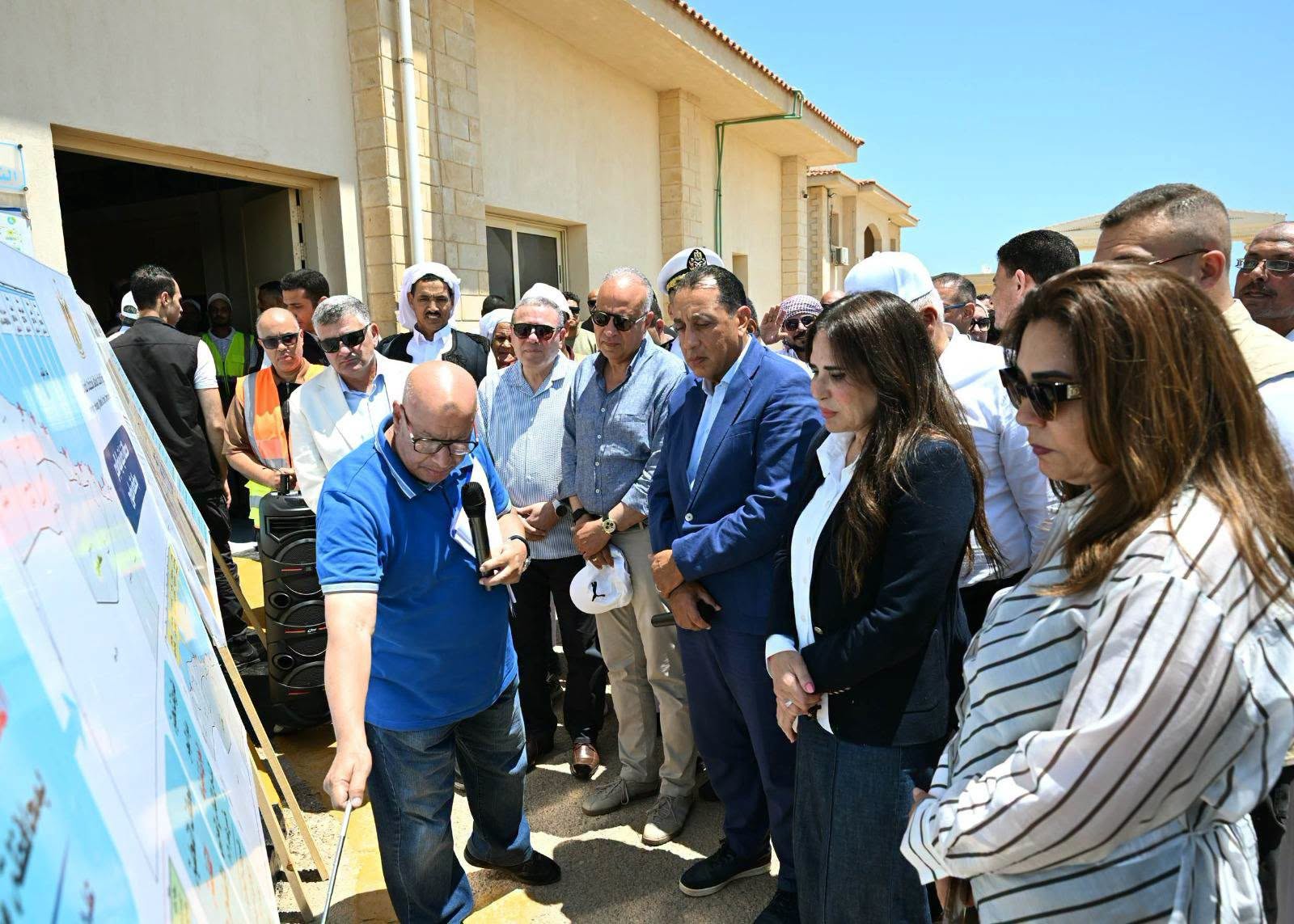
He also reviewed the components of the Al-Rumeila (1–2) desalination plant, noting that the plant has a designed capacity of 48,000 cubic meters per day and includes eight desalination units, in addition to tanks with a total storage capacity of 20,000 cubic meters, making it one of the main sources of drinking water production in Marsa Matrouh. Meanwhile, the Al-Rumeila (3) plant operates with a production capacity of 12,000 cubic meters per day.
The Chairman of the Holding Company for Water and Wastewater also spoke about the Al-Rumeila (4) seawater desalination plant, which consists of four production units and has a capacity of 65,000 cubic meters per day.
He noted that bringing Al-Rumeila (4) into service will enhance the efficiency of the drinking water services system, strengthen supply stability, and improve service levels, as part of ongoing coordination between the Ministry of Housing, the Holding Company for Water and Wastewater, and the relevant authorities to support comprehensive development plans in the governorate.
He also pointed to the possibility of doubling the plant’s production capacity in the future to reach 130,000 cubic meters per day as part of the plant’s expansion plans.
Eng. Mostafa El-Shimy reviewed the plant’s operating system, explaining that the process begins with drawing seawater through the main intake, followed by treatment, purification, and filtration using 24 sand filters, before reaching the desalination units and pumping stations. The produced water is then stored in two tanks, each with a capacity of 10,000 cubic meters.
During the visit, Dr. Mostafa Madbouly also inspected the operation halls and the electrical power supply security system. Eng. Mostafa El-Shimy explained that the system relies on three generators, each with a capacity of 2.5 megawatts, ensuring the plant’s continuous operation under various conditions.
During the inspection tour, the chairman of the holding company for water and wastewater noted that the number of seawater desalination projects included in the strategic plan for Matrouh Governorate through 2050 stands at 10 plants, with a total production capacity of 1.813 million cubic meters per day.
El-Shimy also reviewed the seawater desalination projects currently being implemented along the northwestern coast through 2030. The projects include six plants with a total production capacity of 566,000 cubic meters per day. Meanwhile, the existing desalination plants along the North Coast number eight, with a combined capacity of 360,500 cubic meters per day.
In this regard, the Prime Minister stressed the need to implement the ongoing projects, emphasizing the expansion of the New Alamein desalination plant with a capacity of 150,000 cubic meters per day, in accordance with the scheduled timeline to serve the city.
Dr. Mostafa Madbouly explained that the state is keen to provide the land allocated for establishing seawater desalination projects, considering them among the most important national projects.
At the conclusion of the inspection tour, the Prime Minister stressed the need to ensure the regular operation of the governorate’s drinking water system and monitor the operational status of water plants to guarantee service stability and meet the needs of citizens and visitors, particularly amid the seasonal increase in the number of vacationers during the summer.
He also called for raising readiness levels at all operating sites and responding immediately to any emergencies to ensure sustainable service delivery at the required level of efficiency.