
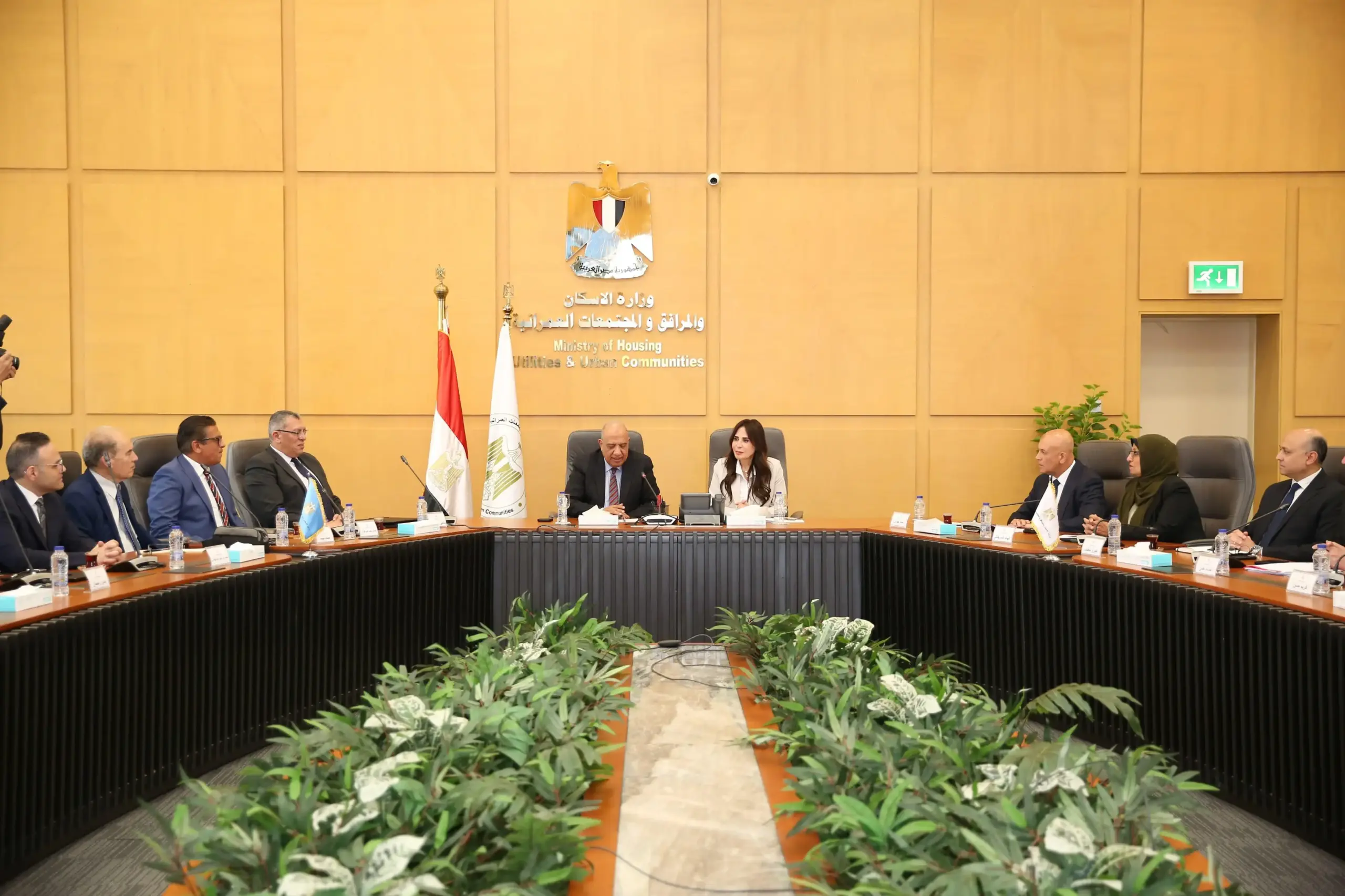
Engineer Randa El-Menshawy, Minister of Housing, Utilities, and Urban Communities, and Dr. Mahmoud Esmat, Minister of Electricity and Renewable Energy, witnessed the signing of a Memorandum of Understanding (MoU) on the “Governance of the Electricity Consumption Rationalization System in New Cities.”
The agreement was signed between the Ministry of Housing, represented by the New Urban Communities Authority (NUCA), and a consortium comprising the National Telecommunications Services Company and EV-INDUSTRIS, in the presence of senior officials from both the ministries of housing and electricity.
The MoU was signed by Eng. Ahmed Ali, Vice Chairman of the New Urban Communities Authority for Utilities, Networks, and Stations Maintenance, Dr. Sami Ali Shadid, Managing Director and Chairman of the National Telecommunications Services Company, and Dr. Tarek Ahmed Abdel Fattah, Chief Executive Officer of EV-INDUSTRIS.
Following the signing ceremony, Engineer Randa El-Menshawy stated that the MoU aligns with the state’s strategy to establish a governance framework for electricity consumption rationalization in new cities. She explained that the initiative supports Egypt Vision 2030 by advancing the transition toward smart and sustainable cities while improving energy efficiency.
The proposed system will manage street lighting by adjusting the brightness (dimming) of LED streetlights based on traffic movement, instead of switching off selected lighting poles. This approach ensures maximum operational efficiency while maintaining public safety and security, and achieves significant savings in electricity consumption allocated for road lighting.
She added that the MoU aims to develop an integrated system for managing and monitoring electricity consumption in new cities through the implementation of advanced smart technologies for collecting, monitoring, and analyzing consumption data. This will enhance operational efficiency, optimize energy use, and provide decision-makers with accurate data to improve performance and maximize resource utilization.
Engineer Randa El-Menshawy emphasized that the Ministry of Housing places great importance on implementing governance principles and digital transformation across all sectors, particularly in the management of utilities and services in new cities. These efforts contribute to the optimal use of resources, reduce operation and maintenance costs, and improve the quality of services provided to citizens.
She also stressed that cooperation with national entities and development partners is a key pillar in implementing smart transformation projects, affirming the ministry’s continued commitment to initiatives that enhance energy efficiency, promote environmental sustainability, and contribute to building smart cities capable of meeting future demands.
For his part, Dr. Mahmoud Esmat affirmed that the electricity sector is working through cooperation, partnership, and integration with all relevant entities as part of a comprehensive plan to reduce electricity waste, rationalize consumption, and improve efficiency.
He noted that the MoU establishes mechanisms for cooperation in several energy-saving initiatives, including a project to replace existing lighting fixtures with high-efficiency LED units to achieve immediate reductions in electricity consumption.
The agreement also explores the implementation of public lighting control systems capable of reducing electricity consumption by more than 30%, depending on operational conditions, through advanced lighting control devices installed within street lighting power distribution panels.
Dr. Mahmoud Esmat added that improving energy efficiency, rationalizing electricity consumption, and utilizing modern technologies in energy management and waste prevention are essential to achieving sustainability.
He emphasized the ministry’s continued implementation of the national energy strategy, including diversifying electricity generation sources and increasing the share of clean and renewable energy in Egypt’s energy mix to 45% by 2028.
He also highlighted ongoing efforts to improve electricity supply quality, enhance energy efficiency, optimize consumption, and elevate service quality through partnerships with the private sector, noting that modern energy management technologies are being deployed across industrial, residential, and commercial sectors.
The minister of electricity further affirmed the ministry’s commitment to supporting, developing, and modernizing the national electricity grid to strengthen energy management and reduce electricity waste across all sectors.
The cooperation protocol aims to establish a preliminary framework for collaboration in providing and implementing integrated smart and sustainable lighting solutions that reduce energy consumption and operating costs, enhance urban safety, and support digital transformation in new cities.
The initiative includes supplying smart lighting units, installing wireless control systems for street lighting networks, and deploying around-the-clock energy and operations management platforms, further supporting the state’s vision for building smart cities.