
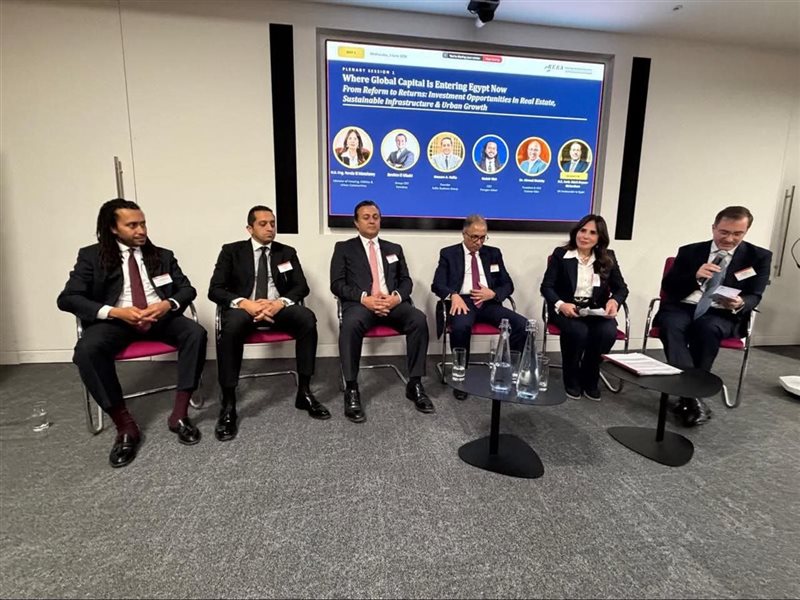
Engineer Randa El-Menshawy, Minister of Housing, Utilities, and Urban Communities, took part in a plenary session titled “From Reform to Return: Investment Opportunities in Real Estate, Sustainable Infrastructure, and Urban Growth.”
The session was held within the framework of the conference “Egypt Future: Investment Opportunities and Sustainable Economic Reform,” organized by the British Egyptian Business Association from June 3 to 5, 2026, in London, United Kingdom. The event forms part of state efforts to strengthen economic cooperation and highlight promising investment opportunities within the Egyptian economy.
The session explored several major topics, including legal protections for foreign investors, incentives for real estate investment, sustainable infrastructure, and mixed-use development projects. It also discussed public-private partnership (PPP) frameworks, land allocation systems, and efforts to streamline licensing and approval procedures.
Additional points included strong domestic demand, rising international investor interest, and the ongoing transition toward planned, fully serviced, and sustainable urban communities. The discussions further covered local financing mechanisms, the role of Egyptian banks in supporting foreign investors, collaboration with international financial institutions, and the importance of sustainable infrastructure as a long-term driver of investment value.
In her remarks, Engineer Randa El-Menshawy stressed that Egypt is pursuing an integrated urban development strategy focused on building sustainable, livable, and investment-ready communities rather than isolated residential projects.
She noted that housing developments are being implemented in parallel with infrastructure, utilities, services, and economic activities, ensuring that new cities are ready to accommodate both residents and investments from the earliest stages.
She further explained that Egypt has invested heavily in infrastructure, road networks, and utilities in recent years, considering them essential pillars for enhancing investment attractiveness and achieving sustainable urban development.
She highlighted that the Egyptian market is supported by strong fundamentals, including continuous population growth, ongoing urban expansion, sustained demand for housing and services, and increasing interest from both domestic and international investors in new urban development opportunities.
The minister also emphasized the government’s commitment to maintaining a stable and attractive investment climate through clear legal and regulatory frameworks that safeguard foreign investments, alongside a wide range of incentives and opportunities in real estate development, sustainable infrastructure, and mixed-use projects.
She added that the state is expanding private sector involvement through public-private partnership models, in addition to offering fully planned and serviced land backed by advanced financing tools and a steadily growing real estate finance market.
She stated, “We believe that successful urban development is not measured by the number of housing units built but by the ability of cities to attract residents, investment, and economic activity in a sustainable way.
Therefore, Egypt is not simply offering real estate projects today, but rather integrated cities and long-term investment opportunities supported by modern infrastructure, strong and growing real demand, a clear sustainable development vision, an evolving regulatory and investment framework, and long-term partnerships aimed at creating sustainable value for all stakeholders.”
She further noted that the Ministry of Housing views memoranda of understanding signed with partners as the beginning of real investment partnerships, not merely cooperation agreements.
She explained that investment opportunities follow a structured institutional process starting with technical and economic feasibility studies, followed by selecting the appropriate investment or partnership model, then completing tendering, allocation, and contracting procedures, and finally moving to implementation and operation stages.
The minister added that Egypt has introduced a series of reforms in recent years aimed at strengthening investor confidence and improving project execution efficiency.
These reforms include enhancing land allocation systems, simplifying licensing and approval procedures, expanding digital transformation, and strengthening public-private partnership frameworks. Together, these measures help accelerate implementation and improve transparency and predictability for investors.
She also emphasized the government’s commitment to balancing the interests of all stakeholders and developing more flexible and efficient contracting models to improve project bankability and enhance attractiveness to financial institutions and international investors.
This is supported by a sophisticated financing ecosystem that includes Egyptian banks, regional and international financial institutions, as well as co-financing and blended finance mechanisms.
She added that while project timelines vary depending on their nature, the ministry continuously works to reduce administrative procedures and speed up decision-making by simplifying processes, standardizing procedures, and improving coordination among relevant authorities.
The minister affirmed that investors are not only seeking opportunities but also clarity, predictability, and speed of execution, noting that the ministry is actively working to strengthen this through the development of a more efficient and flexible investment environment supported by one of the largest and most diversified project portfolios in the region.
In conclusion, she addressed international investors, including British companies, stating, “Egypt today offers not only promising investment opportunities, but also a more mature, stable, and transparent environment supported by modern infrastructure, a clear government vision to enhance the role of the private sector, and the establishment of long-term partnerships that deliver sustainable value for all parties, alongside a diversified financing system.”