
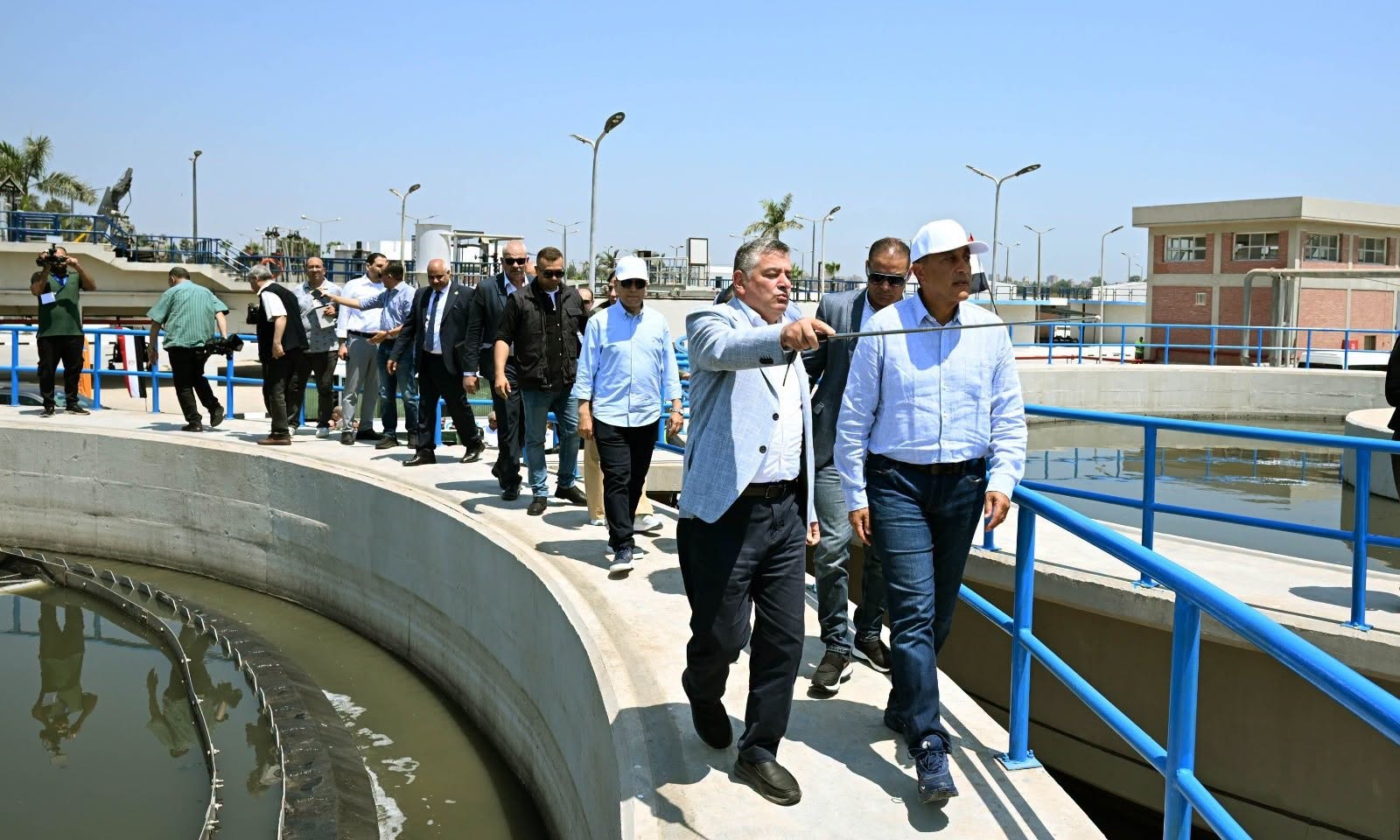
Dr. Mostafa Madbouly, Prime Minister, inaugurated the expansion of the Zefta Wastewater Treatment Plant in Al-Ghareeb Village, Gharbia Governorate, with a designed capacity of 20,000 cubic meters per day. The project is part of the first phase of the presidential “Hayah Karima” (Decent Life) initiative and aims to strengthen wastewater services and improve living standards in Egypt’s rural areas.
The plant was inaugurated during the Prime Minister’s visit to Gharbia Governorate to inspect a number of service and development projects in the presence of several officials. Madbouly emphasized that the wastewater projects being implemented by the state represent a direct investment in citizens’ health and environmental protection, while also supporting comprehensive development in Egyptian villages.
Serving 210,000 People
The expansion of the Zefta Wastewater Treatment Plant serves several villages and hamlets affiliated with Zefta District, including Al-Riyad, Al-Ghareeb, and Kafr Abdel Rahman, in addition to wastewater flows from Zefta City in the Al-Ashara Bridge area, as well as the hamlets of Youssef Gabr, Ezzat, Al-Gendy, and Al-Batrakhana.
The project provides wastewater services to approximately 210,000 people, helping improve environmental and health conditions in the area and increasing the efficiency of services provided to residents.
Project Details
Major General Engineer Mohamed Abdel Fattah, Chairman of the Board of Directors of the Gharbia Water and Wastewater Company, explained that the project included the construction of 66 kilometers of gravity sewer networks and 4 kilometers of force mains, in addition to sedimentation, aeration, and equalization basins.
He noted that the plant operates using an extended aeration system, one of the modern systems used in wastewater treatment, helping achieve high operational efficiency and comply with approved environmental standards.
Status of Drinking Water and Wastewater Projects in Gharbia Governorate
During the tour, the Prime Minister listened to a presentation on the status of drinking water and wastewater projects in Gharbia Governorate. Major General Engineer Amin Shawky, Head of the National Organization for Potable Water and Sanitary Drainage, explained that the organization has implemented and is currently implementing 252 projects in the sector, with a total cost exceeding EGP 15 billion.
He added that 173 projects have been completed, while 60 projects are currently being implemented under the governorate’s investment plan and the second phase of the “Hayah Karima” initiative, in addition to 19 projects under the initiative’s first phase.
Developing Rural Egypt
Eng. Randa El-Menshawy, Minister of Housing, Utilities, and Urban Communities, affirmed that the projects implemented under “Hayah Karima” reflect the state’s commitment to building strong and sustainable infrastructure in rural Egypt, while continuing to implement service and development projects that place citizens at the center of development priorities.
For his part, Major General Dr. Alaa Abdel Moaty, Governor of Gharbia, explained that the expansion of the Zefta Wastewater Treatment Plant represents a strategic project to enhance the efficiency of the governorate’s utility infrastructure, support efforts to develop Zefta District, and improve the quality of life for citizens.