
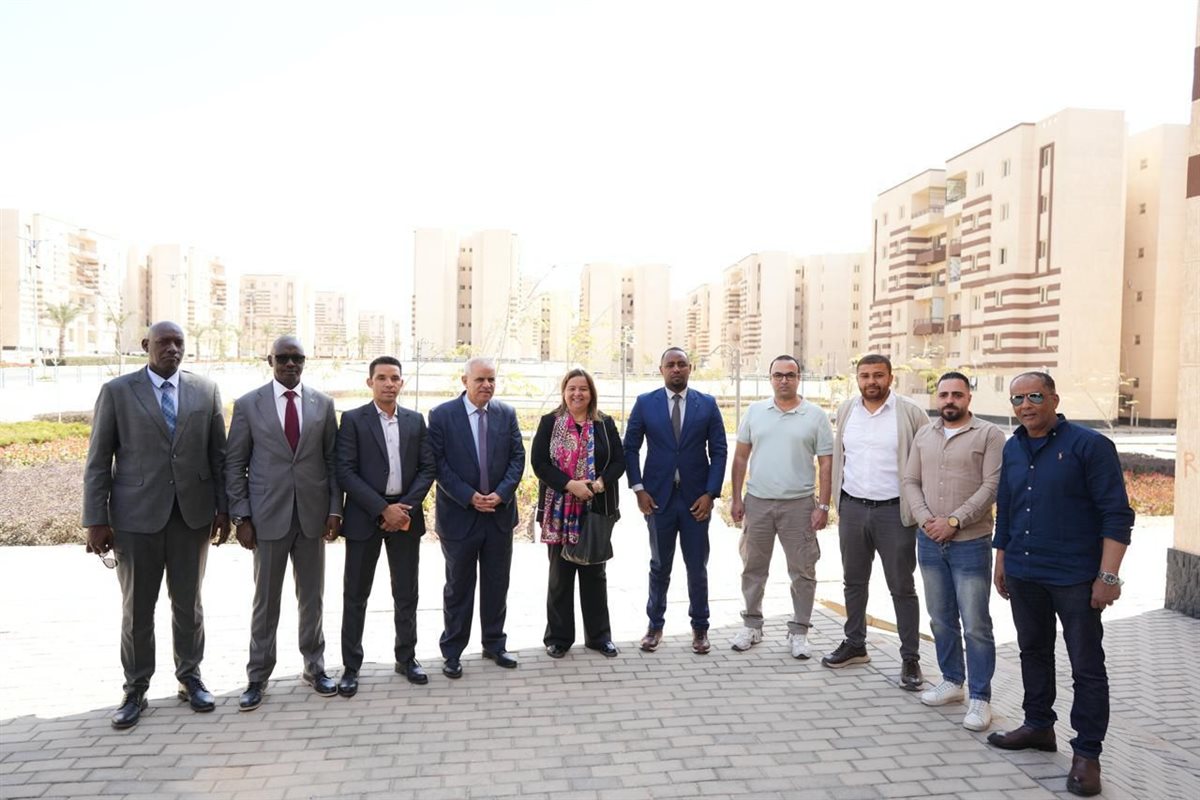
May Abdel Hamid, CEO of the Social Housing and Mortgage Finance Fund, held a meeting with Jean de Dieu Uwihanganye, Rwanda’s Minister of State for Infrastructure, during his inspection visit to housing units under the presidential initiative “Housing for All Egyptians” in Hadayek Al-Asimah City. The visit aligns with the directives of Eng. Randa El-Menshawy, Minister of Housing, Utilities, and Urban Communities.
The Rwandan minister was accompanied by a senior official delegation, including Ambassador Dan Munyuza, Rwanda’s ambassador to Egypt; Sam Kalisa, communications officer; and several high-ranking officials from the Rwandan Ministry of Infrastructure.
At the start of the visit, May Abdel Hamid delivered a detailed presentation on the progress of the presidential initiative “Housing for All Egyptians,” outlining demographic indicators and the scale of challenges and opportunities in Egypt’s housing sector, which records an annual demand of around 400,000 housing units.
She explained that the initiative was launched in 2014 with the goal of providing one million adequate housing units for low-income citizens, ensuring financial sustainability through a mortgage financing system, with implementation handled by the Social Housing and Mortgage Finance Fund. She noted that unified eligibility criteria were developed based on in-depth studies and assessments and are continuously updated to ensure support reaches eligible beneficiaries.
She added that the fund has successfully provided more than one million housing units for low-income citizens, achieving its targets while continuing to offer new units to meet increasing demand, reflecting citizens’ trust due to strict adherence to reservation conditions and timely delivery.
She further stated that 806,000 housing units have been completed, including 637,000 in new cities and 169,000 in governorates, while 205,000 units are still under construction, including 48,000 green housing units. A total of 721,000 units have been allocated to date.
Regarding the middle-income segment, she noted that 32,500 units have been offered, 16,800 units have been completed (14,300 in new cities and 2,500 in governorates), 12,000 units are under construction, and 3,600 units have recently been offered.
She also reviewed the “Green Housing” initiative, which adopts a sustainable development approach by applying green building standards to reduce energy and water consumption, carbon emissions, and waste. She highlighted that more than 25,000 units have received GPRS certification, while over 14,000 units have obtained the international EDGE certification, reflecting Egypt’s commitment to sustainability and improved quality of life.
She pointed out that around 710,000 citizens have benefited from the program, with total support ranging between 50% and 60% of the unit price. This includes direct cash support deducted based on income and indirect support covering infrastructure and land costs, in addition to interest rate subsidies.
She added that mortgage financing provided to beneficiaries reached approximately EGP 2 billion through cooperation with 22 banks and 8 financing companies, offering concessional rates of 8% for low-income groups and 12% for middle-income groups, with repayment periods extending up to 20 years.
She further highlighted key program indicators, including geographic distribution based on population density, with Greater Cairo receiving the largest share. Women represent 25% of ownership, while 47% of beneficiaries are private sector employees and 25% are self-employed professionals.
At the end of her presentation, she provided an overview of Hadayek Al-Asimah City, one of Egypt’s fourth-generation cities located east of Badr City near the New Administrative Capital. The city spans a large area and includes more than 112,000 housing units, alongside integrated services such as schools, healthcare units, nurseries, commercial areas, public service offices, clubs, and sports facilities, offering a fully integrated residential environment.
For his part, Jean de Dieu Uwihanganye expressed strong appreciation for the “Housing for All Egyptians” initiative and its achievements, describing it as a model for providing adequate housing for low-income groups.
He also praised the role of the private sector in implementing housing units instead of relying solely on government entities, noting its contribution to accelerating execution and expanding the program. In this context, May Abdel Hamid confirmed that the fund is preparing to launch a new program for private sector partnership.
The Rwandan minister also inquired about Egypt’s mortgage financing system, stressing that access to financing is a key success factor for such initiatives. He expressed Rwanda’s interest in transferring Egypt’s social housing experience, a proposal welcomed by May Abdel Hamid, who affirmed the fund’s readiness to share its expertise for the benefit of the Rwandan people.
Following the meeting, May Abdel Hamid accompanied the Rwandan minister and his delegation on a field tour in Hadayek Al-Asimah City, where they inspected a green housing unit and a social housing unit. The minister praised the finishing quality, green spaces, and integrated services that support residents’ settlement.
At the conclusion of the visit, both sides agreed to maintain ongoing communication and strengthen joint cooperation in a way that serves the interests of both friendly nations.