
In implementation of the directives of Eng. Randa El-Menshawy, Minister of Housing, Utilities, and Urban Communities, Eng. Ahmed Omran, Deputy Minister of Housing for Utilities, accompanied by Eng. Mostafa El-Shimy, Chairman of the Holding Company for Water and Wastewater, and Major General Ashraf Barakat, Head of the Executive Authority for Drinking Water and Wastewater, inspected a number of stations and projects in Qalyubia Governorate to follow up on their implementation and operational status and assess the level of services provided to citizens.
The inspection tour was also attended by Dr. Salah Bayoumi, Vice Chairman of the Holding Company for Water and Wastewater, Eng. Mohamed Fouda, Chairman of the Qalyubia Drinking Water and Wastewater Company, and a number of Ministry of Housing officials. The delegation began its tour by inspecting the Saryaqous Drinking Water Treatment Plant, with a design capacity of 145,000 cubic meters per day.
The delegation reviewed the plant’s components and various operational stages, starting with the intake and raw water pumping station, through the chlorine and alum systems, filters, and backwash water treatment units, as well as the ground tank, treated water pumping station, and plant laboratory, in order to assess the technical condition of the various components and identify maintenance and efficiency-enhancement needs.
Plant officials emphasized during the tour the importance of the Saryaqous Plant within the drinking water supply system, as it serves the villages of Al-Khanka Center, except for the Abu Zaabal area. The Deputy Minister of Housing directed officials to adhere to planned and preventive maintenance programs and respond promptly to technical requirements, ensuring optimal utilization of the plant’s design capacity and sustainable service delivery.
The delegation also inspected the Qashish Wastewater Treatment Plant as part of the projects of the first phase of the presidential “Decent Life” initiative. The Qashish plant has a design capacity of 15,000 cubic meters per day and serves approximately 120,000 residents in the villages of Al-Hazaniya, Qashish, Kom Al-Saman, Al-Gaafra, Arab Al-Shaara, Al-Salmaniya, Al-Atara, and Al-Ghariri and operates using secondary treatment. The final discharge of treated water is directed to the Al-Hazaniya Drain.
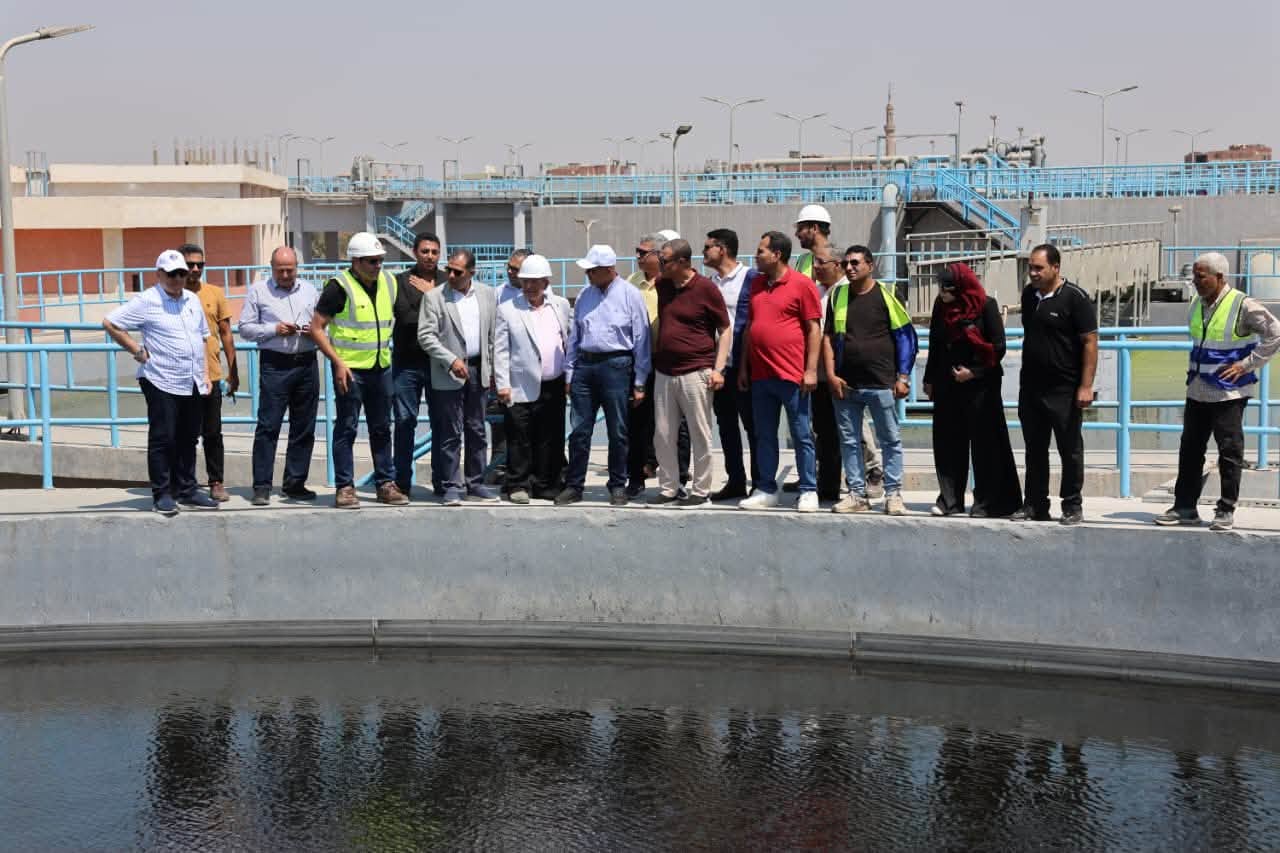
The tour also included the Nob Taha Wastewater Lifting Station, one of the projects of the first phase of the presidential “Decent Life” initiative. The station serves Nob Taha village, with a design capacity of 38,000 cubic meters per day.
It includes four submersible pumps and a 4,320-meter-long discharge line with a diameter of 800 mm, extending to the Kom Al-Ahmar Lifting Station. The delegation followed up on the regularity of operations and the technical condition of the station’s equipment.
The Deputy Minister of Housing and his accompanying delegation also inspected the Nob Taha Drinking Water Plant, one of the projects of the first phase of the presidential “Decent Life” initiative, with a design capacity of 10,000 cubic meters per day.
The delegation reviewed the regular operation of the plant and its role in supporting and improving the drinking water system in the area. Construction of the plant began in July 2022 and was actually completed in April 2025.
Eng. Ahmed Omran affirmed that the tour comes within the framework of the directives of Eng. Randa El-Menshawy, Minister of Housing, for continuous field follow-up of projects, particularly those implemented under the presidential “Decent Life” initiative, which is considered one of the most important national projects aimed at improving the quality of life in the Egyptian countryside and achieving a tangible and sustainable improvement in the level of basic services provided to citizens.
Eng. Ahmed Omran also highlighted the importance of improving performance rates at drinking water and wastewater companies and enhancing the efficiency of the operational system, while paying particular attention to quality and laboratory operations. He also stressed the need to increase collection rates and reduce non-revenue water through intensified programs to replace faulty meters and identify and address illegal connections and unauthorized water use.
For his part, Eng. Mostafa El-Shimy affirmed that the Holding Company continuously follows up on “Decent Life” projects in coordination with its subsidiaries and executive authorities, with the aim of expediting the commissioning of projects and maximizing their benefits.
He noted that the objective is not limited to establishing new projects but also extends to ensuring sustainable and efficient operation and preserving the investments and assets that have been implemented. Eng. Mostafa El-Shimy, Chairman of the Holding Company for Water and Wastewater, highlighted the importance of expanding the activation of the “Master” program at drinking water and wastewater stations, which contributes to improving maintenance efficiency and maintaining the readiness of equipment and assets.
He explained that the company is currently developing predictive maintenance programs using Egyptian expertise and personnel from the company’s engineers. These programs rely on installing a set of sensors on operational components and equipment to continuously monitor and measure technical variables and indicators, enabling early prediction of failures before they occur, reducing downtime and maintenance costs, extending the service life of equipment, and ensuring sustainable and efficient operation.
Dr. Salah Bayoumi, vice chairman of the holding company, affirmed that achieving sustainable benefits from “Decent Life” projects requires establishing clear operation and maintenance programs and preserving assets while monitoring performance indicators and equipment efficiency to ensure that the projects continue to perform their intended role at the targeted level of efficiency.
During the visit, Eng. Mohamed Fouda, chairman of the Qalyubia Drinking Water and Wastewater Company, reviewed the overall status of the drinking water and wastewater systems in the governorate. He explained that the company provides services to approximately 5.36 million residents.
The drinking water system comprises 161 production plants with an actual capacity of approximately 808,000 cubic meters per day, as well as networks extending for approximately 6,620.6 km, while drinking water coverage stands at 99%.
The Chairman of the Qalyubia Water Company also reviewed the wastewater system, which comprises 28 treatment plants and 242 lifting stations, with a total network length of approximately 4,003 km. The volume of wastewater collected across the governorate amounts to approximately 418,000 cubic meters per day, while wastewater service coverage stands at 85.8%.
The presentation also addressed the status of projects under the first phase of the presidential “Decent Life” initiative in the Shibin Al-Qanater Center. The works covered 36 villages and included drinking water networks in the targeted villages, seven water plants, and 13 wastewater network projects, in addition to household connections.