
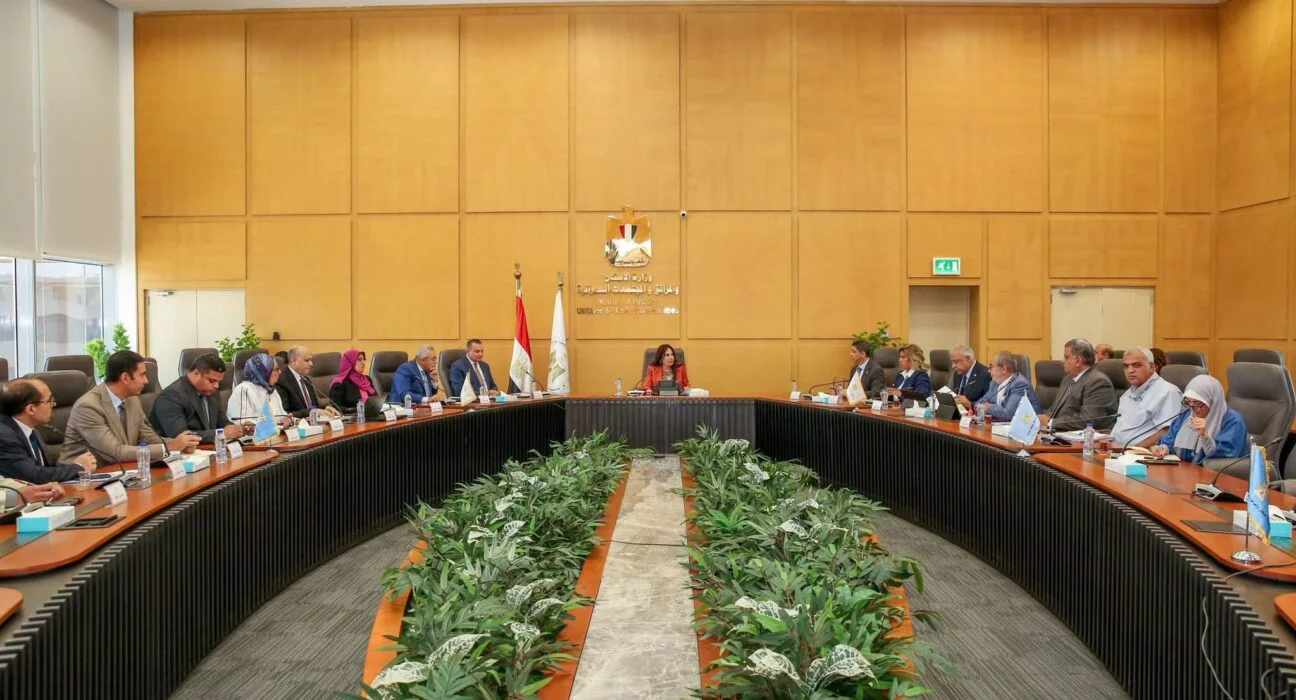
Eng. Randa El-Menshawy, Minister of Housing, Utilities, and Urban Communities, held a meeting to follow up on the latest developments in the implementation of the “Fustat Hills Park” project, which spans 500 feddans in the Old Cairo area of Cairo Governorate. The project is being implemented by the Ministry-affiliated Central Agency for Reconstruction.
The meeting was attended by Eng. Khaled Sediq, Chairman of the Urban Development Fund; Major General Hany El-Iskandarani, Chairman of the Central Agency for Reconstruction; Ministry officials; and the project consultant. Eng. Randa El-Menshawy emphasized that the state attaches great importance to the development of the Fustat area, considering it one of Cairo’s most important historical and cultural areas.
She noted that the “Fustat Hills Park” project represents a qualitative leap in restoring the area’s cultural and urban character through the establishment of an integrated cultural and tourist destination that includes a diverse range of activities, services, and recreational, cultural, and investment facilities.
The minister explained that the project aims to maximize the site’s added value and make optimal use of its natural and historical assets. It will also provide open spaces and recreational, cultural, and service areas that offer a distinctive experience for citizens and visitors while ensuring the preservation of the area’s historical character and urban identity.
She noted that the Ministry is keen to deliver the project in the best possible form, in a manner that reflects the importance and status of the Fustat area and enhances its ability to attract citizens, tourists, and investments. The meeting reviewed the implementation status of the various components of the “Fustat Hills Park” project, including the investment zone and the Arena project.
The investment zone is being developed on an area of 131,000 square meters overlooking Ain Al-Hayat Lake and includes 12 restaurants, four commercial malls, and four parking garages, in addition to a rear area designated for major official celebrations and events, featuring the Roman Theater, a water fountain, and landscaping works.
The Minister of Housing also followed up on the implementation status of the cultural zone and the river area. The cultural zone is located opposite the project’s main gate and includes a main axis in front of the National Museum of Egyptian Civilization, surrounded by a number of plazas designated for cultural activities, restaurants, and services.
It also includes the main gate, four restaurants and cafeterias with a total building area of 216 square meters, and three fountains, in addition to an area of 26,864 square meters, qualifying the zone to host celebrations and events throughout the year. The meeting also addressed the implementation status of the adventure zone, which includes a number of service buildings, lakes, landscaping works, and a playground area.
It also includes three service buildings: a children’s play building covering 505 square meters, a service building covering 167 square meters, and a restroom building covering 167 square meters, in addition to utility works and landscaping across an area of 97,238 square meters.
The minister also followed up on the works in the hills and valley zone, which includes three hills of varying heights, with the “river” waterway running between them. The hills are arranged in a series of terraces beginning at the river’s edge and extending to the hilltops, providing distinctive views of the project, the surrounding area, and the Saladin Citadel.
The meeting also reviewed the implementation status of the markets zone, a commercial area being developed on 60,000 square meters. The zone aims to stimulate tourism, support the national economy, and preserve and develop traditional and heritage crafts, most notably glassmaking, ceramics, candle-making, spinning, and weaving.
The zone is being implemented in three phases and includes 19 commercial shops, parking areas, an artificial lake, green spaces, and a three-star hotel. At the conclusion of the meeting, Eng. Randa El-Menshawy emphasized the importance of continuing field follow-up on the various components of the project; ensuring full coordination among all relevant entities, implementing companies, and the project consultant; and promptly addressing any obstacles.